6 July 2026
A New Micro-moth that Inhabits Where Others Do Not
Moths often make their homes in unexpected places. Some are so specialized they are only found where their host plants grow, and are diminishing as the particular habitats and environmental conditions they evolved with disappear. Others are doing the opposite: as human activity and industrialization alter the vegetation and vary temperatures, they’re increasing in number and expanding northward.
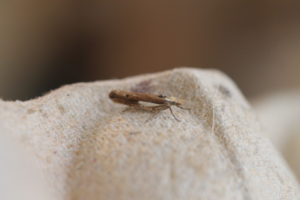
This week, our moth trap had a new micro–species that’s one of the latter sorts: Homoeosoma sinuella, a small and slim–bodied species with three wide brown lines that zig-zag down its wings. Sinuella (meaning ‘curved’), refers to this oscillating pattern, and its genus means like–body due to the like abdomens of the different sexes. It likes dry, chalky soils, old sand dunes, brush that runs alongside railway tracks, and places that have been cleared out by humans and overrun with weeds. Its larvae eat large cavities in the roots of ribwort plantain and others of the Plantago genus, plants typically torn out of gardens rather than consciously planted. Our field guide says the moth is ‘extending its range,’ with recent first–time recordings in Northumberland and parts of Ireland, likely due to its compatibility with human activity–affected habitat. They have a definitively scrappy look to them and seem so suited to dry weediness that they almost feel out of place in our lush English garden. They’re certainly welcome though, as they add to our biodiversity.
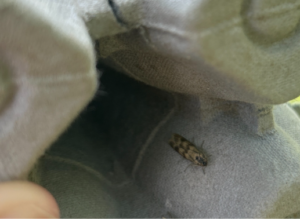
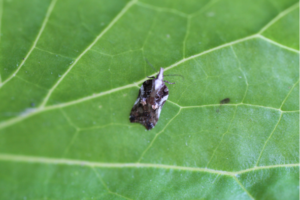
Eudonia lacustrata, a small black-and-white moth, was another new micro find. It’s almost invisible on stone and tree trunks, where it rests during the day, but stands out on any green background. Its larvae feed on mosses, where they also pupate in spun silk tubes.
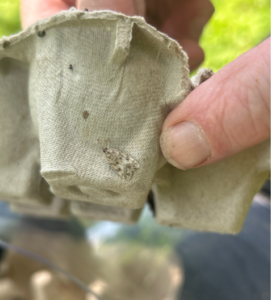
Another micro-moth species, the Green Garden-Veneer (Chrysoteuchia culmella), numbered in the dozens. It seemed like legions of this tiny white and gold–trimmed insect were springing from the trap onto arms and tree branches and into test tubes. Feeding on a variety of grasses, they are drawn to grasslands, meadows and like H. sinuella, waste grounds. They rest on these same grasses during the day, and according to the guide, are ‘easily disturbed’ and ‘can be abundant,’ which was certainly the case in our moth trap.
Last summer, UPenn intern Sophia Hernandez discovered two other new micro-moth species for Shandy Hall – the Tufted Tortrix (Acleris cristana) and Ypsolopha parenthesella. The Tortrix’s typical range is the Midlands and southward, so it’s a rare treat to have it up here in North Yorkshire. It’s an extremely varied species, with over 130 known morphs, but all share the semi-concaved rectangular shape and tufts of scales halfway down their wings. This one had a dignified black and silver color scheme and slightly worn golden wing tufts. They prefer wooded areas and feed on flowering trees like hawthorns and apples. Interestingly, the adults often hibernate, flying from August to November and then again from March to May. Y. parenthesella is another autumn flyer, which is fitting because it’s the beautiful burnt sienna color of apple cider and fallen leaves. It also lives in woodlands, but favors oaks, hornbeams and birches.
Though microlepidoptera populations have certainly been affected by habitat loss, pesticide use, and a number of other human–caused issues, recent research suggests that in some ways they might be more resilient than their macro counterparts. Simply due to their smaller body size, their flying ranges are much smaller, meaning they can more easily adapt to smaller patches of habitat than larger moths and might be less affected by the changes in temperature and humidity that come with climate change. They might not be as gloriously gaudy as the Elephant Hawk or as elegant as the Willow Beauty, but it’s still worth it to keep an eye out for them in the garden.
No new macros were discovered this week, but we did have an especially confusing find! The very aptly named Uncertain, (Hoplodrina alsines), has an uncanny resemblance to the closely related Rustic Moth. At first, ObsIdentify deemed it the latter, but on closer inspection I thought the more apparent brown band in the middle of its wings suggested it was H. alsines. A Rustic would have been a new species, but it’s unfortunately down to close genital inspection or dissection to be sure of which it is, and I’m qualified for neither.
Other species spotted:
Beautiful Hook-tip, (Laspeyria flexula)
Clay, (Mythimna ferrago)
Riband Wave, (Idaea aversata)
Straw Dot, (Rivula sericealis)
Willow Beauty, (Peribatodes rhomboidaria)
Post by Sarah Leonard (UPenn intern 2026)
Recent Moths
- Two Final New Micromoths
- Three More New Micromoths
- Three Majestic New Micromoths
- Invasion of the Beet-Army Worms
- Sarah Gillespie’s Mezzotint Moths
- A Visit From the Privet Hawk-Moth
- The Splendid Scarlet Tiger
- An Uncertainty of Species
- A New Micro-moth that Inhabits Where Others Do Not
- Brown Moths and ‘Binsey Poplars’
- SHANDY HALL MOTH LIST to August 2025 (alphabetical with links)
- Rise of the AI Naturalist