6 September 2026
Two Final New Micromoths
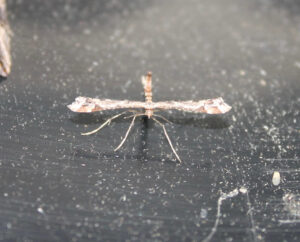
Shandy Hall has another Plume Moth! And it’s not just any Plume: Amblyptilia acanthadactyla is commonly known as the Beautiful Plume, which is very fitting for its precise geometric pattern, finely shaped wings and intense gaze. This one allowed only a brief look before it darted off into the orchard garden.
The Plume Moths of the Pterophoridae don’t really look like moths at all; they seem more like some sort of arachnid–dragonfly hybrid, or like a more attractive version of a crane fly. Their strange wing shape is their most defining feature: both the front and back wings are divided into two to three segments that spread out in flight but are harder to see at rest. This gives them their distinctive feathery, ‘plumed’ silhouette.
A. acanthadactyla is one of the more common of Britain’s Plume Moths, and has been increasing in number since 1990. It’s also one of the few moths that is able to overwinter in Yorkshire as an adult. There are only two recorded sightings of its larvae in the county, both on hedge woundwort, but it feeds on the flowers and seeds of a range of plants like heathers, mints, and goosefoots.
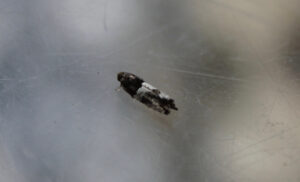
Gypsonoma aceriana has two conflicting common names: the elegant White Cloaked Tortrix and the more menacing Poplar Shoot-borer. Many moths, especially the micro-lepidoptera, have a range of differing colloquialisms along with the official scientific name. They vary regionally, contextually, and temporally : a farmer is more likely to recognize a moth based on the crops it feeds on, while an amateur lepidopterist will probably know the moth by its Victorian name. Some argue that moths shouldn’t need common names, that they often make things unnecessarily confusing, and I agree that identification can get messy when different sources have multiple names for the same moth. But common names can also be fun, and they make insect appreciation a little more accessible for those without a background in Greek and Latin. ‘Tortrix’ (for example) is a great word.
G. aceriana is a very localized species, most common in Southern England and Wales, scarcer further North and virtually unheard of in Ireland and Scotland. As one of its common names implies, the larvae feed on poplar, especially buds and new growth which earns them their unfavorable pest reputation in some places.
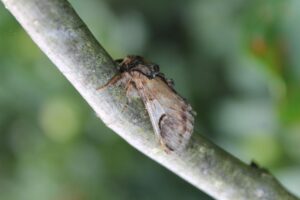
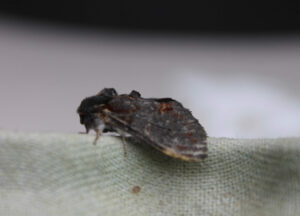
On my first perusal through the moth field guides, my eye was caught on page 238, which is full of illustrations of the Notodontidae family, or the prominent and kitten moths. With their stunning side profiles, sturdy bodies and long, fur-like scales, they look mythical in the way only aeons of evolution can invent. Our first few traps were sadly devoid of these beauties, but recent traps have attracted a few of their species, and this final trap gave me the chance to see four of the gorgeous fawn-hued Pebble Prominent (Notodonta ziczac) and the exquisite Iron Prominent (Notodonta dromedarius). The only one I was glad not to see was the Oak Processionary (Thaumetopoea processionea), whose larvae are currently causing havoc in Berlin due to the floating, microscopic and rash-inducing hairs they release.
The Pebble Prominent feeds on sallow and poplar, while the Iron Prominent prefers birch trees. Most of the ones in this trap, though still magnificent, looked a little worse for wear, with bald patches and some very ragged wings. They likely had laid their eggs already, hopefully choosing trees nearby, so the next generations will come to Shandy Hall’s light traps next summer. I was sad to see them go when we released this group, but I wished them luck as they flitted out into the August dusk.
Post by: Sarah Leonard (UPenn intern 2026)
Recent Moths
- Two Final New Micromoths
- Three More New Micromoths
- Three Majestic New Micromoths
- Invasion of the Beet-Army Worms
- Sarah Gillespie’s Mezzotint Moths
- A Visit From the Privet Hawk-Moth
- The Splendid Scarlet Tiger
- An Uncertainty of Species
- A New Micro-moth that Inhabits Where Others Do Not
- Brown Moths and ‘Binsey Poplars’
- SHANDY HALL MOTH LIST to August 2025 (alphabetical with links)
- Rise of the AI Naturalist