21 July 2026
A Visit From the Privet Hawk-Moth
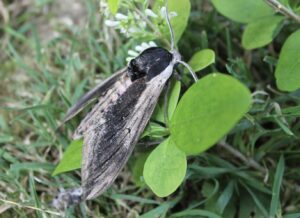
Looking into the moth trap this week, my attention was almost immediately caught by what seemed to be a small torpedo covered in fur. Growing up to 6 cm long and with a 9-12 cm wingspan, the Privet Hawk-Moth (Sphinx ligustri) cuts a very imposing figure. On its thorax was a large brown and white hump, almost cattle–esque, and its wings were dramatically huge even when folded.
Despite its conspicuous size, the Privet Hawk is actually a seasoned town–dweller, commonly found in urban green spaces like parks and private gardens. Some gardeners even see their larvae as pests, as they often feed on Privet hedges, Lilacs, and other cultivated shrubbery. Giant and lime green, with purple and white stripes and a thorny–looking tail, the Privet Hawk’s larvae look like they could do some harm, but they don’t cause any extensive damage to gardens. In fact, the adults are important night–flying pollinators, so they help plant life much more than they harm it!
Linnaeus’s mythology–referencing names are often enigmatic, and it’s unclear exactly what’s behind the naming of this genus, but S. ligustri definitely has the same stately elegance as the Sphinx. This one was sleeping pretty heavily, though, so it luckily didn’t ask us any riddles!
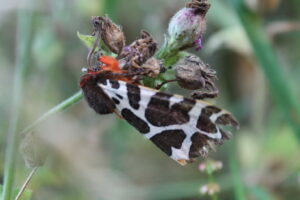
The Garden Tiger (Arctia caja) looks like something you might see on a safari. Its striking brown–and–white print falls somewhere between leopard and giraffe, and the wide splay of its antennae makes them look distinctly antler–like. It’s a previously recorded species, but it’s not a very common visitor, so it was an exciting find in this week’s trap!
Though armed with irritating hair on its larvae and predator–warning bright orange underwings, the Garden Tiger has been swiftly declining in number since the 1980s. It makes its habitat in hedgerows and weedy areas, so the use of pesticides and clearing out of this kind of vegetation is partly to blame for its recent rarity. Studies have also shown that changing winter weather patterns are also a cause: the increase in mild Januaries preceding harsher Februaries is often lethal for the Garden Tiger’s overwintering larvae. Because this cycle will likely only worsen as the climate warms, the moths will be increasingly threatened. Reducing the spraying of pesticides and growing more of their foodplants, like Nettle and burdocks, could be helpful to sustain this struggling species.
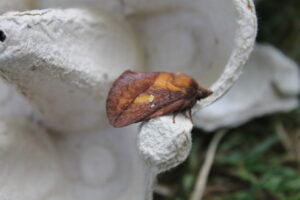
I’ve been waiting to sight a hedgehog since I arrived here, but have unfortunately not managed to find one. Fortunately, there’s a moth that looks almost like a hedgehog: The Drinker (Euthrix potatoria)! With its sweetly protruding snout and goldeny–brown furred body, this moth looks more mammalian than most and has quickly become one of my favorites. Its common name comes from the larvae’s habit of sipping dew from plant stems. How can you get more adorable than that?
When releasing this batch of moths, we faced an ethical dilemma: one of the species identified is a known and brutal garden pest, and we weren’t sure if it should be pardoned or culled. Originally from East Asia, it was first seen in the UK in 2007 and has quickly become one of the most formidable insect infestations facing gardeners today. They’re strong fliers, rapidly expanding their territory, and have multiple generations in a single year. One caterpillar can quickly become a colony, and even hungry birds are having trouble keeping up! This time, we decided to let the moth go in peace, but we may have to amend that if it keeps coming back.
Post by Sarah Leonard (UPenn intern 2026)
Recent Moths
- Two Final New Micromoths
- Three More New Micromoths
- Three Majestic New Micromoths
- Invasion of the Beet-Army Worms
- Sarah Gillespie’s Mezzotint Moths
- A Visit From the Privet Hawk-Moth
- The Splendid Scarlet Tiger
- An Uncertainty of Species
- A New Micro-moth that Inhabits Where Others Do Not
- Brown Moths and ‘Binsey Poplars’
- SHANDY HALL MOTH LIST to August 2025 (alphabetical with links)
- Rise of the AI Naturalist