27 July 2026
Invasion of the Beet-Army Worms
Spodoptera exigua is a moth that goes by many names: the Beet-Army Worm in its native Asia, the Small Mottled Willow Moth in the British Isles, the Asparagus Fern Caterpillar in its larval form and, to anyone growing produce, one of the world’s most ruthless agricultural pests.
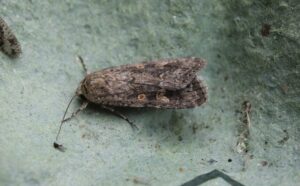
You could easily miss it at first glance: slim, scruffy and gray–brown, its only distinguishing features are two pink or orange spots and the distinctive way it wraps its forewings at rest. Despite there being no previous record of it at Shandy Hall, I counted at least six specimens lurking in this week’s trap. I guess they travel in groups!
Beginning its territorial expansion in the late nineteenth century, the Beet-Army Worm is now found worldwide. Though it can’t tolerate cold temperatures and dies in the UK’s harsh winters, the adults invade again each spring. Unfortunately, this is just enough time for them to do their damage: larvae appear about a month after the adults on host plants ranging from peas, lettuce and potato to cotton and tobacco. They can completely defoliate small shrubs and prefer to eat buds and new growth, which prevents plants from flowering and fruiting.
Harmful pesticides are usually the first strategy deployed to get rid of them, but there are other more interesting methods, too! Predatory insects like fire ants can hunt down the caterpillars, and certain parasitic insects will lay their eggs within them so their larvae can eat the grub when they hatch. Pheromone traps, which attract and trap moths by emitting synthetic breeding pheromones, are also used. Still, the moths and their larvae often spread so quickly that it’s necessary to hand pick them off the foliage.
Though not exactly a welcome visitor, S. exigua does bring our species tally up to 445. It presents us with yet another ethical dilemma, however: if growers are working so hard to rid their farms of these moths, should we be simply releasing them again? Or would it be a breach of scientific conduct to harm any of our data–giving specimens? We haven’t come to any conclusions just yet, but keep an ear out for if we do!
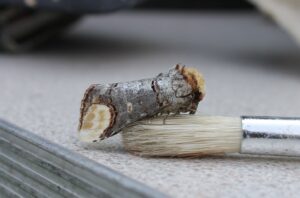
I was more excited to see a living birch tree branch in our trap this week, otherwise known as the Buff-Tip (Phalera bucephala). With its lunar silvery sheen and the moon–like markings at the bottom of its wings, it looks like some sort of woodland alien spaceship. Most moths have an otherworldly look to them, but this one looks especially like it’s visiting from a distant galaxy.
I was surprised to find out that this moth, too, is sometimes considered a pest species! The larvae live ‘gregariously,’ according to UK Moths, feeding ravenously on sallows, birches, oaks and hazels. They’re also common eaters of apple trees and have been known to devour entire branches. Obviously this isn’t fun for their foodplants, but I was charmed by this moth’s lifestyle: the first half as a sociable caterpillar, flocking to dinner parties on broadleaved trees, and the second half as a nocturnal master of camouflage.
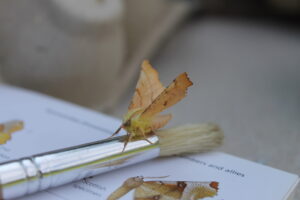
We also had two interesting thorn species: the Early Thorn (Selenia dentaria) and the Canary-shouldered Thorn (Ennomos alniaria). Yorkshire’s most common Thorn, the Early Thorn sees two generations each summer: first from February to May and then from July to September. Moths of the second generation, like this one, are smaller with lighter gray and more vibrant orange on their wings. They frequent woodland, hedgerows, parks and gardens and eat a variety of woody plants like Hawthorn, Hazel and Honeysuckle.
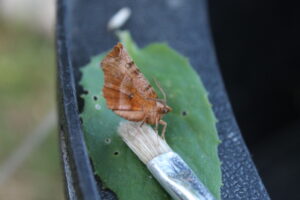
The Canary-shouldered Thorn is aptly named for its bright canary-colored thorax. Its larvae feed on birches, alders, elms as well as limes (not the kind that produces fruit, but it still feels fitting for a moth that’s so citrus–colored). It’s another species that almost doesn’t feel like it should be real, looking more like a cartoon than something that lives in woodlands, but I was still glad to see it in the trap!
)
Recent Moths
- Two Final New Micromoths
- Three More New Micromoths
- Three Majestic New Micromoths
- Invasion of the Beet-Army Worms
- Sarah Gillespie’s Mezzotint Moths
- A Visit From the Privet Hawk-Moth
- The Splendid Scarlet Tiger
- An Uncertainty of Species
- A New Micro-moth that Inhabits Where Others Do Not
- Brown Moths and ‘Binsey Poplars’
- SHANDY HALL MOTH LIST to August 2025 (alphabetical with links)
- Rise of the AI Naturalist